
An octave band splits a sound into frequency ranges, so you can see where its energy sits and not just how loud it is overall. When a consent or licence sets limits at particular frequencies, or you need to tell which source is dominant, the octave bands are how the level is broken down.
What an octave band is
An octave band is a range of frequencies where the highest frequency is twice the lowest. The full-octave set used for environmental noise has ten bands, named by their centre frequencies from 31.5 Hz up to 16 kHz. Instead of one overall level, you get a level in dB for each band.
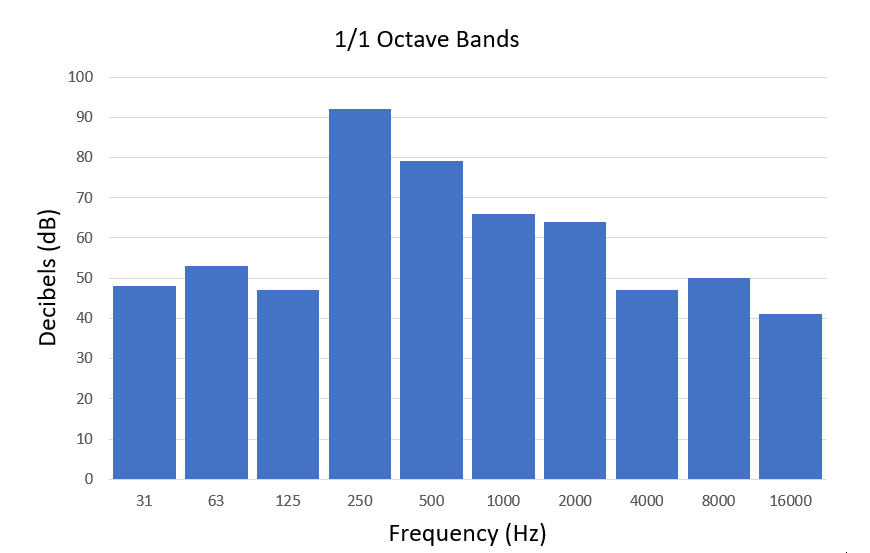
In this example the overall level is made up of ten bands, and the dominant one is at 250 Hz. That is the kind of detail an overall LAeq cannot give you.
Full octave and one-third octave
Full octave (1/1) bands: ten bands. Enough to see whether a noise is mostly low, mid or high frequency.
One-third octave (1/3) bands: each octave split into three, so thirty bands over the same range. The finer breakdown is what you need when a limit is set at a specific frequency, or to pick out a tonal component such as a hum or a whine.
Why it matters on site
Some development consents, environmental management plans and operating licences set noise limits at specific frequency bands rather than as one overall level. Most often that is a limit on low-frequency noise, because low frequencies travel further, pass through walls more easily and are felt as much as heard. The related topic on the vibration side is ground-borne noise, which is low-frequency sound arriving through the ground and the structure.
The breakdown also points to the source. A level dominated by the low bands typically comes from plant, engines and compressors; a level dominated by the high bands typically comes from alarms, tools and metal on metal.
Octave bands and your SiteHive devices
SiteHive Hexanode Noise devices are tested against IEC 61672-3 for sound level meters and IEC 61260-1, the standard for octave-band and fractional-octave-band filters. See SiteHive Hexanode Noise: what it measures and how and NATA calibration.
In SiteHive Enviro Pro, every noise event carries a spectrogram, which shows the energy of the sound by frequency over time: Events: investigate an exceedance.
Vibration uses the same idea: the Vibration Criterion (VC) curves are assessed in one-third octave bands from 1 Hz to 100 Hz.
ℹ️ If your consent sets limits per octave band, talk to your Regional Success Manager about the reporting your project needs, or email help@sitehive.com.
What's next
SiteHive Hexanode Noise: what it measures and how (the parameters the device records and the standards it meets)
Ground-borne noise (low-frequency sound that arrives through the structure)
Investigating a spike? Events: investigate an exceedance (images, audio, direction and spectrogram for each exceedance)